Home, written June of 2015.
That’s the question I asked myself when I took a trip home after not seeing home for eighteen years.
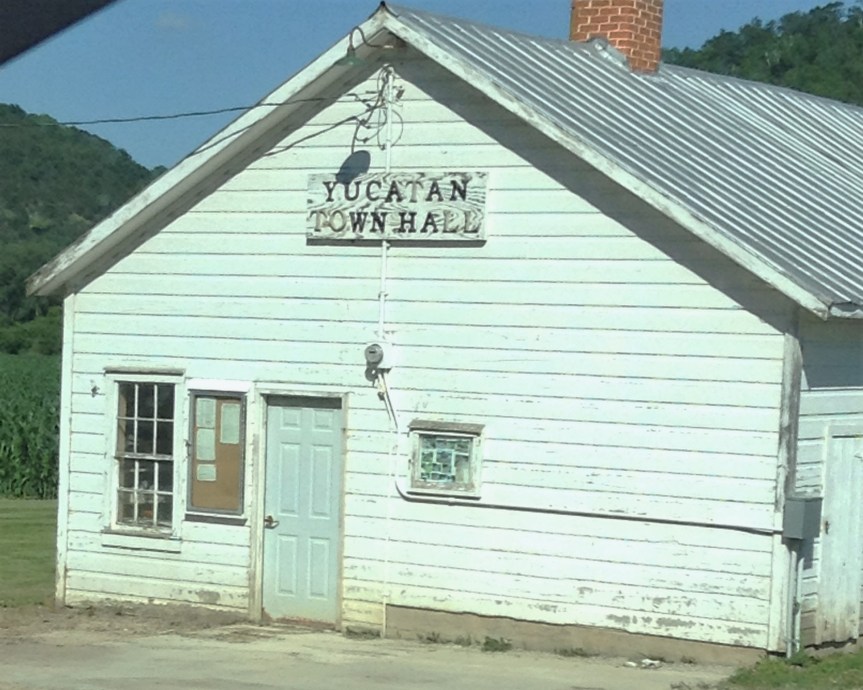
The building pictured above is a building I spent a lot of time in growing up. It’s the building we held our 4-H meetings in every month. This is also where my dad went to school, attending up to eighth grade. Later it was used by the township for meetings and voting. Driving home, I wasn’t sure what I would find, as contact with the people that may or may not still be living at the home place was broken many years ago. The main reason for my visit was that I wanted to visit my dad’s grave, but I also wanted to see how the home place looked. Previous to driving out to where I grew up, my husband and I traveled around two counties looking at all the places I had lived before we married. It seemed like a million years ago that I lived in any of those places. Since then, I or we’ve lived in Wisconsin, Seattle, and a suburb close to Chicago.
You know when you take a trip down memory lane, you think things will feel just as they did the last time you were there. I went into this trip, which was suggested by my husband, more curious than anything to see if home still felt like home. To see if I missed coming home. To see if home had changed. The last time I was home was right after my dad died unexpectedly to attend a memorial service for him. Sometimes that day is very clear in my mind, and other times it seems like a million years have gone by since I last talked with him, saw him, and then said goodbye to him.
When we got to the cemetery, we decided not to go in. It’s a private cemetery, and I no longer felt a part of the people who lived here or kept it private. Noticing that I felt that way was a surprise to me. Another surprise was that it didn’t really hurt to feel this way. I accepted it. There sure seemed to be a lot more headstones than I ever remembered being there. Maybe it wasn’t so private anymore? To think he was in this tiny plot of land that he spent his whole life farming around seemed so surreal to me. Driving by the farm I grew up on didn’t seem to stir any feelings in me besides sadness. No more milk cows, no more farming (or at least it didn’t look like there was) no farmer in sight and buildings dilapidated. I never realized until I looked at the farm and the house I grew up in that it’s just a house and a barn without its Farmer John living there. It looked like any other abandoned farmstead we’d driven by that day. I thought the house and lawns would look as they once looked—pristine and well cared for. But, instead, machinery and bikes and stuff sat across the lawn, and the old place had that well-worn, lived-in look to it. I imagine my mother, if she was home, maybe taking a nap. There’s no way to ever know. I thought for sure I would cry, but no tears came. Time steals many emotions; it steals many opportunities, and time definitely has taken from me my longing for home. Home is where you make it; it is where you are and who you are with. My home is the place I lay my head down in every night. My home is the place I clean and spend time laughing in and loving my family in. My home is in my heart; it’s a place of peace and a place of calm. The home I grew up in still sits in Yucatan Valley, but the man who made it my home is gone. The farmer who I called Dad, who worked tirelessly day in and day out to provide a beautiful farm for his family to live on, is gone. And so, sadly, is the farm he spent his life’s work on.
I’m not entirely sure why I let so many years go by. I really shouldn’t have. Some people, when they feel hurt, shut down. I shut down. When a family member wrote to me to tell me that she had “found me” a few years back, and that both she and the rest of my family had thought me dead, I felt really hurt. That statement wasn’t literal, because why then would they look for me? It also wasn’t factual, because I was very much alive and all over the internet, so no one could think me dead. That statement was meant to hurt me, probably because that family member felt hurt. And hurt it did. It served its purpose. Returned letters do too, and refusing to return emails, and blocking me on Facebook. It all hurt. Words in her letters that excluded me like I had never existed hurt too. I let my hurt shut me down. And then after a couple of years of hurting, I began to heal. Through prayer, the patience and unconditional love of my husband, and learning to trust again, I learned to let people back into my life. People who weren’t lying to me, who truly wanted me in their life and unconditionally accepted me for who I was and am. I’ve never really expected too much from people. But I do expect from people the same as I give, and that’s unconditional love, support, honesty, and true friendship.
My feelings of hurt and anger have caused me a lot of grief, and I’ve wasted a lot of time feeling that way. Where most families would forge together quickly to right a wrong and mend feelings and stick together, mine didn’t. I never went home after my dad died because I was afraid I would find happy people living happily ever after without me. The other truth to tell is that I’ve been busy with life and all the things we all get busy with—surviving, bills, debt, personal issues, health, travel, and family. I’ve never taken the time to think about closure or my part or where I fit in all of the hurt. But I have now.
Once I started writing my book, I began to clearly see my part in all the events of my past. Writing has helped me to understand why I stayed away so long. When we drove past the farm that I grew up on, I didn’t see happy people; I didn’t see anyone. My people, the people I am with every day and building a life with, are happy. The people that have been living their lives without me, as if I am dead, I’m not sure. I don’t know them anymore, and subsequently they don’t know me. They’re gone from my life. A long time ago they made a choice, and so did I. And there is nothing any of us can do to turn back time. In the interim we’ve all had choices to make and live by. In my world, my family was always alive, and the possibility to make amends and come back together always existed. Yet even when family offered hope in that direction, I knew that it wasn’t a completely honest attempt. I also knew that without trust—being able to trust someone and being able to trust that what they are offering is as beneficial to you as it is to them—a relationship cannot be renewed. And sure enough, when I declined, true intentions and the truth were revealed. That is no foundation in which to rebuild a torn relationship. If I’ve learned anything through the years, it is that people will show you who they really are. Without question, if they’ve written you off as dead or are cruel enough to say something like that, they will also use lies to get what they want. So through the years I’ve had a lot to work through. I’m not going to pretend to know if my family has had to work through things, but I do know from my standpoint it’s been a lot of emotional feelings and awakenings and hurt to work out. Unlike my family felt towards me, I wasn’t able to pretend they were dead. I also wasn’t able to forget them so that I could move on. I had to do something so that I could live a happier life while still honoring their presence in my past. Driving back home to the farm was my closure. It was a way to say, after almost eighteen years of hope, fear, rejection, distance, pain, anger, and pride—goodbye.
Throughout the last eighteen years I’ve experienced many emotions. Guilt and regret are ugly feelings. Guilt destroys people because it’s a feeling that feels like helplessness—no way out. But there is a way out; you just need to deal with your feelings and learn how to cope with your mistakes. How do you ever get past those helpless, harmful feelings? For me, I had to get past them because my sobriety depended on it. I owed everyone who loved me, myself included, the best version of me. And so I worked through it and accepted I was human and I make mistakes, and I’ve learned to live with them. I don’t run, I don’t hide, and I don’t cover them up with substance abuse anymore. As far as regret, regrets will eat you up. I’ve learned to never do anything I don’t think I can live with. I have done things in my life that were wrong; I’ve admitted to them and continue to admit to them, and I move on. Because not admitting them and trying to move forward means you”ll end up staying right where you are. I’ve learned to apologize over the years, something that was hard for me to do growing up. I’m usually the first person to say I’m sorry and sit down and try to work things out. I’m big on actions, not big on words when it comes to fixing problems, issues, and/or relationships.
I feel I learned from my trip back “home” that you can always go home, but the home you once knew may not always be there. And while in your life you may be sad because you were never brave enough to face rejection, or you didn’t know how to make amends with the people you love, you have to at least consider that the people you love may be busy hating you or writing you off as dead. I feel as though I’ve turned a corner, and even though it hurts to think that things are the way they are, I am glad for the closure. I saw a lot of things that day as I drove through the valley and through Houston, the town I grew up in, that helped to satisfy the questions in both my heart and mind. The school I attended seemed so small, and the main drag seemed so empty, almost abandoned. Everything used to feel so big, and now, after so many years, I can see it for what it really is: just a small town filled with people I don’t know, where I once lived, a long, long time ago. We stopped in a town called Caledonia for lunch and drove by where I used to work and also where I once lived for a short while. We drove by a few other places of interest and laughed and laughed at some of the things we saw. Like a lot of things in life, seeing it is believing.
I am glad my husband insisted that we drive out to the farm that I grew up on. It will always and forever be in my mind, somewhere, and often during certain seasons. I will always hold in my heart the land that I trampled on pretending to play horse, the barnyard that I played school in, the kittens that I discovered, the cats that I loved, the echos of the milk pump, water pump, whippoorwill calls at night, my mother calling for me to come in, my brother’s reluctant smile, my father wiping the sweat from his brow, my sister running into trees learning to ride a bike, boys to chase, and the cigarettes I smoked from my bedroom window on a cold winter’s night. That life, that farm, and that family long gone from me.
 savoringmysixties