If you celebrate the day–Happy Thanksgiving from us to you and yours

Until next time, be well and be safe.
If you celebrate the day–Happy Thanksgiving from us to you and yours
Until next time, be well and be safe.
🌿 August Reset: A Gentle Pause Before the Final Push
August is the soft exhale between summer’s wild bloom and autumn’s golden discipline. It’s not quite the end, not quite the beginning. It’s the stillness before the turn.
In many ways, August feels like a second chance at a new year.
By this point, we’ve lived through over half the calendar year—some of our intentions from January may have bloomed beautifully; others wilted quietly. Life has shifted, as it always does. And that’s okay. Growth isn’t always linear. But August? August invites us to pause, reset, and breathe.
Here’s how to embrace an August Reset—gently, intentionally, and in alignment with who you are now (not who you thought you’d be back in January).
Ask yourself:
August isn’t about pressure. It’s about awareness. No shame, no guilt—just honesty.
Declutter one small area of your life—your desk, a drawer, your inbox, your thoughts. Make space for clarity.
Try a simple ritual: light a candle, make your favorite drink, and write down what you want to leave behind this month. Burn it (safely) or tear it up. Let it go.
Choose one habit that will support your well-being and energy for the rest of the year. Not ten—just one.
Maybe it’s:
Reset doesn’t mean overhaul. It means realign.
What do you want your life to feel like as the year closes?
Not the achievements or the numbers—but the rhythm. The atmosphere. The peace. Then, ask: what small shifts can you make in August to start cultivating that energy?
Write a note to your December self. Describe what you hope they’re proud of. What you hope they feel. What you hope they remember about this August—that you slowed down long enough to hear yourself again.
Seal it. Save it. Open it when the year ends.
You don’t need to catch up. You’re not behind. You’re right on time.
Let August be your gentle invitation to begin again—not from scratch, but from experience.
Happy Reset Season 💛
Branches, foliage, pinecones, needles, moss, dried flowers, and so much more. Natural, pure Nordic style.
Image Source — article on Nordic design and style.
xoxo

I often tell people edit is my middle name. I love to edit things. Some of the easiest things I edit are the junk drawer, my handbag, even my make-up bag. To edit is to condense or modify. Editing is usually associated with written material but has recently become associated with decluttering or living with less or sorting through/sorting out.
This past weekend I completed several edits. The first edit was a handbag edit. I had been using the same bag, a black leather Coach handbag, for ten years. It’s been lovely and I’ve got a lot of use out of it, but it’s too heavy and the strap is always falling down. After looking at close to 200 different handbags online last week I finally found one that is lightweight, has two sections in it, two straps, and was very affordable. Today that handbag arrived and I was able to sort through all of the stuff in my old bag, throw a lot of the stuff away, and then fit everything I was keeping into my new bag. The new handbag is a bit more up to date, definitely more stylish than my last one, and is way easier on my back and shoulders. Handbag edit successful and complete.
Closet editing is done often around here. If items aren’t worn after a year they are donated. If items are looking shabby-sweaters pulled out of shape, pilling going on, holes or tears they are thrown. Often clothing items just don’t fit anymore with me, my lifestyle, my figure etc. and they also get donated.
Junk drawers–I actually have one and it gets edited regularly. I stand over it in our kitchen with the trash can and when I can’t remember why I hung onto this or that, or even sometimes identify what it is or why I’m holding onto it-nail, screw, bread tie, newspaper clipping–it’s thrown.
Even in social media regular editing can take place. I often look through my photos on Instagram and if they look too personal, or dated, or revealing or they just don’t match the profile of who I am and what I am sharing about myself, family or business on the internet, I delete them. I also purge Facebook photos and posts on a regular basis–this way what is available about me and mine is less likely to end up in a Google or Facebook search/search all. Though I work hard to produce blog content with good grammar, I often fail. So when I can, I go back to posts and edit them. I do this all the time.
Editing is an important part of my life. I don’t like to be overwhelmed–my best line of defense for that is edit, regularly trim down the size of today’s list, prioritize things on my lists, and accomplish what I can today, and save the rest for tomorrow. I don’t consider it a failure to not get every little thing on my list completed.
Editing is an important part of my life because I am a minimalistic person. Chaos causes me more stress than any order ever will. If you don’t mind chaos or can adapt, I envy you. I don’t consider my minimalistic attitude and all the work it sometimes takes to always be positive. However, paring down closet space so it contains what you actually wear is fabulous. I’ve been organizing professionally for six months now without hiring any assistants. Soon I will be looking to build a small team. As of this time I am asked the most about closet organizing. I would say I’ve probably organized more closets for clients at this point than anything else. Sometimes a closet is a great starting place, and for me thus far I’m having a great time doing them.
xoxo
if you prefer.
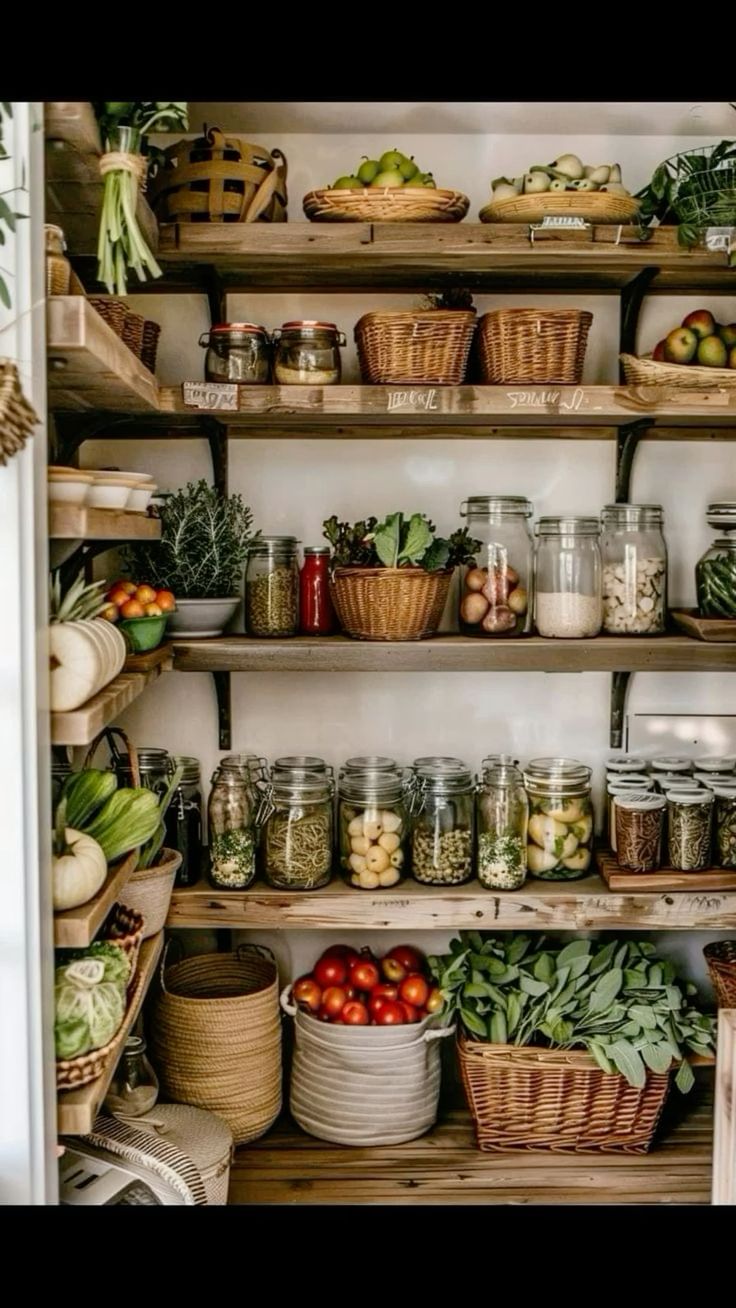
Early ingredients in grandma’s pantry would have been flour, sugar, salt, herbs, dried flowers, medicinals, and tinctures. There would also have been some meat in a salt brine and gunny sacks or crates of potatoes. In the early pioneer days, settlements were usually a day or more trip to get provisions. Homesteads generally had at least a flock of chickens and a family milk cow—this was a lot to possess in the old days. Though, of course, there were also many folks without any livestock who likely hunted or fished for the protein in their diets. Canned foods would begin to be sold in New York City in 1812, they were popular in wars, but wouldn’t be considered to be 100% safe until mechanically processed in 1850. Some of the first canneries were Libby’s, Underwood, Bordens, and Nestle.In 1910, women were encouraged to begin canning their own food for their families and leave the factory-produced canned foods in stock for the war effort.
Since the time of the influenza pandemic of 1918, consumers have steadily moved away from freshly and locally produced foods to larders filled with shelf-stable items.
https://www.acumence.com/the-history-of-canning-and-can-making/
By the 1950s, our grandmothers had discovered cans of tuna, aspic, Campbell’s soup, Spam, oatmeal, koolaid, corn syrup, and mayo.
In September of 1953, Swanson sold its first TV dinner.
GMOs were developed in 1973 and began being used in our food system in 1982. There are now food products in our food system that can survive forever—apparently a Twinkie and Spam can.
I always laugh when I hear anyone my age or older say that they’re going to stock their pantry like grandma did. My grandma was like most women, born in the last years of the 1800s and married in the 1920s. She canned meat, potatoes, various kinds of pickles, peaches, and tomatoes. She had a root cellar with root vegetables and a pantry with flour, rice, sugar, salt, and spices. Everything she canned seasonally was eaten up by the next season. Nothing, absolutely nothing, was wasted.
Food preppers often recommend stocking up and surviving entirely off of canned goods. My opinion?well, they’ll probably survive whatever happens, but their health will be another matter. I know a lot of people don’t pay attention to use by dates or are confused with best buy. Just know that depending on how the item you have in the freezer was processed, prior to freezing, determines how long the product retains its nutrients. Also, processed/frozen foods and frozen meat are almost always high in sodium. The chart below gives the time table for how long you can freeze meat and retain freshness, flavor, and nutrients vs. what it says on its label, or how long you know it has been in the freezer, or whether you care or not how old it is before you eat it. Personally, I’m not buying anything to store in a freezer that I wouldn’t eat in 6 or 12 months. I can go without frozen food for a day or two or even a week or two if that’s the case should something happen where I couldn’t buy food. There is no way that I have the capital to go out and purchase freezers full of food for a what if, then worry about keeping them going in a power outage, only to have to throw the food or God forbid eat food that is no longer fresh, tastes good, and lacks all nutrients. No, no, nope.
https://www.foodsafety.gov/food-safety-charts/cold-food-storage-charts
If you have a stash in the freezer and have gone out and bought a generator—you should know, depending on how many appliances you plan to run on it, a good-sized generator will need 50-100 gallons of fuel for 1 week. Judging by how fast gas stations shut down in a crisis, if you don’t have that on hand, you might want to develop another backup plan.
Here are some foods that can help you stay healthy and survive at the same time—rice (freeze then dry can), protein bars, pumpkin puree, squash—if you can store them safely, beans of any kind, and canned meat of any kind. You need a good amount of protein, vitamins, hydration, fiber, and personally, I would make sure I had a ferment or two in my pantry–kimchi, sauerkraut, cabbage, beet kvass, pickles.
Until next time,
xoxo
 savoringmysixties